


Page 5 - iiA
P. 5
President’s Communique


           Elevating Our Impact: The Power of

           Communication in Internal Audit


           Dear Members,


           As we turn the page on May – Internal Audit Awareness Month, I want
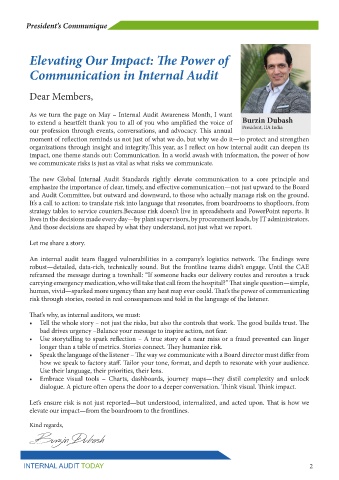
           to extend a heartfelt thank you to all of you who amplified the voice of   Burzin Dubash
           our profession through events, conversations, and advocacy. This annual    President, IIA India
           moment of reflection reminds us not just of what we do, but why we do it—to protect and strengthen
           organizations through insight and integrity.This year, as I reflect on how internal audit can deepen its
           impact, one theme stands out: Communication. In a world awash with information, the power of how
           we communicate risks is just as vital as what risks we communicate.

           The new Global Internal Audit Standards rightly elevate communication to a core principle and
           emphasize the importance of clear, timely, and effective communication—not just upward to the Board
           and Audit Committee, but outward and downward, to those who actually manage risk on the ground.
           It’s a call to action: to translate risk into language that resonates, from boardrooms to shopfloors, from
           strategy tables to service counters.Because risk doesn’t live in spreadsheets and PowerPoint reports. It
           lives in the decisions made every day—by plant supervisors, by procurement leads, by IT administrators.
           And those decisions are shaped by what they understand, not just what we report.

           Let me share a story.


           An internal audit team flagged vulnerabilities in a company’s logistics network. The findings were
           robust—detailed, data-rich, technically sound. But the frontline teams didn’t engage. Until the CAE
           reframed the message during a townhall: “If someone hacks our delivery routes and reroutes a truck
           carrying emergency medication, who will take that call from the hospital?” That single question—simple,
           human, vivid—sparked more urgency than any heat map ever could. That’s the power of communicating
           risk through stories, rooted in real consequences and told in the language of the listener.


           That’s why, as internal auditors, we must:
           •  Tell the whole story – not just the risks, but also the controls that work. The good builds trust. The
               bad drives urgency –Balance your message to inspire action, not fear.
           •  Use storytelling to spark reflection – A true story of a near miss or a fraud prevented can linger
               longer than a table of metrics. Stories connect. They humanize risk.
           •  Speak the language of the listener – The way we communicate with a Board director must differ from
               how we speak to factory staff. Tailor your tone, format, and depth to resonate with your audience.
               Use their language, their priorities, their lens.
           •  Embrace visual tools – Charts, dashboards, journey maps—they distil complexity and unlock
               dialogue. A picture often opens the door to a deeper conversation. Think visual. Think impact.

           Let’s ensure risk is not just reported—but understood, internalized, and acted upon. That is how we
           elevate our impact—from the boardroom to the frontlines.

           Kind regards,
           Burzin Dubash


         INTERNAL AUDIT TODAY                                                                                 2

