


Page 58 - IAT_April_2025_Magazine
P. 58
Harmonising Ethics and Culture in


                             Global Auditing Practices


         Global Risk Management Institute
         Priyanshu Soni


         Introduction                                          What are Ethics in Accounting?


         In accounting, ethical dilemmas are very often to     Ethics in accounting pertains to the moral principles
         come, like misrepresentation of financial data or     and standards that govern the application of
         any other. And accountants are expected to have       accounting practices. These principles emphasize
         a very high standards of integrity in accounting      values  and  rules  to  ensure  honesty,  integrity,
         but when you face a challenge in real world there     objectivity, and fairness in financial reporting and
         are scenarios will be present in which you have to    decision-making.
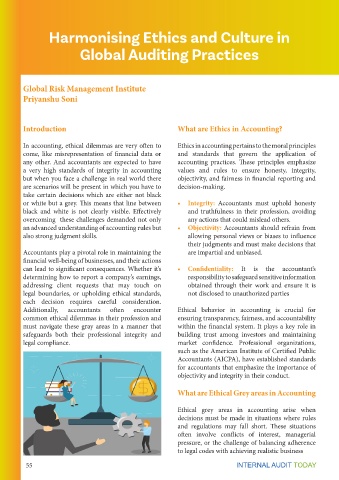
         take certain decisions which are either not black
         or white but a grey. This means that line between     •  Integrity: Accountants must uphold honesty
         black and white is not clearly visible. Effectively       and truthfulness in their profession, avoiding
         overcoming  these challenges demanded not only            any actions that could mislead others.
         an advanced understanding of accounting rules but     •  Objectivity: Accountants should refrain from
         also strong judgment skills.                              allowing personal views or biases to influence
                                                                   their judgments and must make decisions that
         Accountants play a pivotal role in maintaining the        are impartial and unbiased.
         financial well-being of businesses, and their actions
         can lead to significant consequences. Whether it’s    •  Confidentiality: It is the accountant’s
         determining how to report a company’s earnings,           responsibility to safeguard sensitive information
         addressing client requests that may touch on              obtained through their work and ensure it is
         legal boundaries, or upholding ethical standards,         not disclosed to unauthorized parties
         each decision requires careful consideration.
         Additionally,   accountants    often   encounter      Ethical behavior in accounting is crucial for
         common ethical dilemmas in their profession and       ensuring transparency, fairness, and accountability
         must navigate these gray areas in a manner that       within the financial system. It plays a key role in
         safeguards both their professional integrity and      building trust among investors and maintaining
         legal compliance.                                     market confidence. Professional organizations,
                                                               such as the American Institute of Certified Public
                                                               Accountants (AICPA), have established standards
                                                               for accountants that emphasize the importance of
                                                               objectivity and integrity in their conduct.


                                                               What are Ethical Grey areas in Accounting


                                                               Ethical grey areas in accounting arise when
                                                               decisions must be made in situations where rules
                                                               and regulations may fall short. These situations
                                                               often involve conflicts of interest, managerial
                                                               pressure, or the challenge of balancing adherence
                                                               to legal codes with achieving realistic business

          55                                                                        INTERNAL AUDIT TODAY

