


Page 68 - IAT_April_2025_Magazine
P. 68
Under the Surface
c lt re dit
i pr ctice
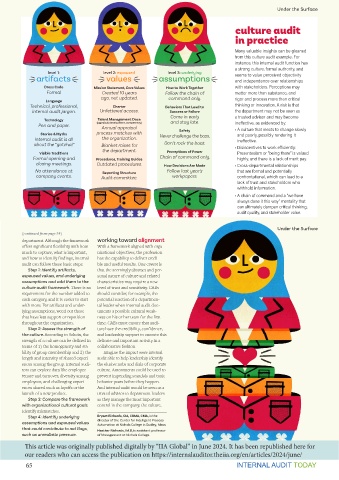
Many valuable insights can be gleaned
from this culture audit example. For
instance, this internal audit function has
a strong culture, formal authority, and
level 1: level 2: espoused level 3: underlying seems to value perceived objectivity
artifacts values assumptions and independence over relationships
Dress Code Mission Statement, Core Values How to Work Together with stakeholders. Perceptions may
Formal Created 10 years Follow the chain of matter more than substance, and
ago, not updated. command only. rigor and process more than critical
Language
Technical, profes sional, Charter Behaviors That Lead to thinking or innovation. A risk is that
internal audit jargon. Unfettered access. Success or Failure the department may not be seen as
Come in early a trusted advisor and may become
Talent Management Docs
Technology (appraisal, development, competency) and stay late. ineffective, as evidenced by:
Pen and paper. Annual appraisal • A culture that reacts to change slowly
Safety
Stories & Myths process matches with Never challenge the boss. and poorly, possibly rendering it
Internal audit is all the organization. ineffective.
about the “gotcha!” Blanket raises for Don’t rock the boat. • Disincentives to work efficiently:
the department. Perceptions of Power
Visible Traditions Presenteeism or “being there” is valued
Formal opening and Procedures, Training Guides Chain of command only. highly, and there is a lack of merit pay.
closing meetings. Outdated procedures. How Decisions Are Made • Cross-departmental relationships
No attendance at Reporting Structure Follow last year’s that are formal and potentially
company events. Audit committee. workpapers. confrontational, which can lead to a
lack of trust and stakeholders who
withhold information.
• A chain of command and a “we have
always done it this way” mentality that
can ultimately dampen critical thinking,
audit quality, and stakeholder value.
Under the Surface
(continued from page
) Internal Auditor 55 June 2024
department. Although the framework working toward li e t
offers significant flexibility with how With a framework aligned with orga-
much to capture, what is important, nizational objectives, the profession
and how to identify findings, internal has the capability to deliver credi-
audit can follow these basic steps: ble and useful results. One caveat is
Step 1: Identify artifacts, that the seemingly abstract and per-
espoused values, and underlying sonal nature of culture and related
assumptions and add them to the characteristics may require a new
culture audit framework. There is no level of trust and sensitivity. CAEs
requirement for the number added to should consider, for example, the
each category, and it is easier to start potential reaction of a departmen-
with more. For artifacts and under- tal leader when internal audit doc-
lying assumptions, weed out those uments a possible cultural weak-
that have less support or repetition ness on his or her team for the first
throughout the organization. time. CAEs must ensure that audi-
Step 2: Assess the strength of tors have the credibility, confidence,
the culture. According to Schein, the and leadership support to execute this
strength of a culture can be defined in delicate and important activity in a
terms of ) the homogeneity and sta- collaborative fashion.
bility of group membership and ) the Imagine the impact were internal
length and intensity of shared experi- audit able to help leadership identify
ences among the group. Internal audi- the elusive nobs and dials of corporate
tors can explore data like employee culture. Assessments could be used to
tenure and turnover, diversity among prevent impending scandals and toxic
employees, and challenging experi- behavior years before they happen.
ences shared such as layoffs or the And internal audit would be seen as a
launch of a new product. trusted advisor to department leaders
Step 3: Compare the framework as they manage the most important
with organizational cultural goals. control in the company: the culture.
Identify mismatches.
Step 4: Identify underlying Bryant Richards, CIA, CRMA, CMA, is the
assumptions and espoused values director of the Center for Intelligent Process
Automation at Nichols College in Dudley, Mass.
that could contribute to red flags, Heather Richards, Ed.D, is assistant professor
such as unrealistic pressure. of Management at Nichols College.
This article was originally published digitally by “IIA Global” in June 2024. It has been republished here for
56
June 2024
Internal Auditor
our readers who can access the publication on https://internalauditor.theiia.org/en/articles/2024/june/
65 INTERNAL AUDIT TODAY

