


Page 47 - iiA
P. 47
•  Employee engagement and attrition indicators        Post Crisis Reforms:
         •  Internal control overrides and red flags

                                                                Post the 2008 bribery scandal, Siemens undertook
         •  Performing Cultural Audits                          sweeping reforms in compliance, internal audit,
                                                                and corporate governance. It overhauled the
         Auditing “culture” means evaluating the unwritten      Internal Audit function to not only test controls
         rules, values, and assumptions that guide decision-    but also evaluate ethics, tone at the top, and
         making. IA conducts cultural assessments using         cultural indicators. Siemens’ IA team began routine
         interviews, employee surveys, focus groups, and        “cultural audits” that assessed whether ethics and
         behavioral analytics to gauge ethical climate, risk    compliance training were effectively influencing
         escalation  behaviors, and  alignment with  stated     on-the-ground behaviors. The audit findings were
         values.                                                used to revise leadership development programs
                                                                and to tailor employee engagement strategies for
         Challenges Faced by Internal Audit                     high-risk regions and business units. Siemens’
                                                                post-crisis audit and compliance transformation
         Embedding a  risk-aware  culture  is  complex.         has  been  recognized  as  a  leading  example  of
         Internal Audit often faces the following challenges:   how internal audit can support ethical culture
                                                                rebuilding after a crisis.
         •  Cultural Resistance: Employees may resist
             perceived oversight or  fear  consequences  of     Example: Financial Services Industry
             transparency.                                      Case: Barclays Bank (UK)
         •  Inconsistent Risk Frameworks:  Legacy               Background of the Case:
             systems or fragmented policies can create
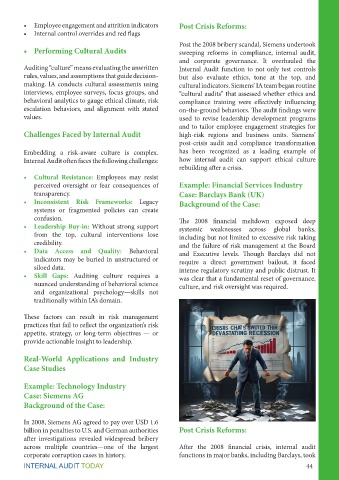
             confusion.                                         The  2008  financial  meltdown  exposed  deep
         •  Leadership Buy-in: Without strong support           systemic weaknesses across global banks,
             from the top, cultural interventions lose          including but not limited to excessive risk taking
             credibility.                                       and the failure of risk management at the Board
         •  Data Access and Quality: Behavioral                 and Executive  levels.  Though Barclays did  not
             indicators may be buried in unstructured or        require a direct government bailout, it faced
             siloed data.                                       intense regulatory scrutiny and public distrust. It
         •  Skill Gaps:  Auditing  culture  requires  a         was clear that a fundamental reset of governance,
             nuanced understanding of behavioral science        culture, and risk oversight was required.
             and organizational psychology—skills not
             traditionally within IA’s domain.

         These  factors  can  result  in  risk  management
         practices that fail to reflect the organization’s risk
         appetite, strategy, or long-term objectives — or
         provide actionable insight to leadership.

         Real-World Applications and Industry

         Case Studies

         Example: Technology Industry

         Case: Siemens AG
         Background of the Case:


         In 2008, Siemens AG agreed to pay over USD 1.6
         billion in penalties to U.S. and German authorities    Post Crisis Reforms:
         after  investigations  revealed  widespread  bribery
         across  multiple  countries—one of  the  largest       After the 2008 financial crisis, internal audit
         corporate corruption cases in history.                 functions in major banks, including Barclays, took
         INTERNAL AUDIT TODAY                                                                                44

